Filter by what founders actually say

We read 638 product pages ourselves and only recorded a claim when the page said it in its own words, with the sentence quoted. This is a small, growing slice of the full catalog, not a replacement for it.

89 contact criteria (public email, LinkedIn, country, registered company) are only available to signed-in members.

Clear all filters

16 products match every selected criterion

Local markdown note-taking app that stores notes as plain .md files on disk for people who want to own their data, instead of a cloud-locked notes app.

Works offline
What to know
How it works
Stores notes as plain text .md files directly on disk; you choose your own sync method or stay fully offline.
Best for
People who want full control of their note files rather than relying on a vendor's cloud storage.

Watched for 27 days · last checked 1d ago

Details →

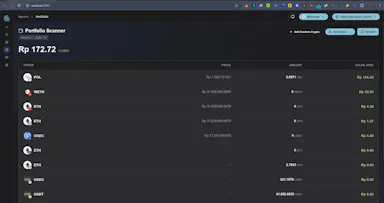
A non-custodial runtime for autonomous on-chain Web3 agents that keeps private keys isolated client-side, positioned as a personal Web3 assistant.

What to know
How it works
A non-custodial runtime for autonomous on-chain Web3 agents with client-side key isolation, built on a Node.js/React monorepo.
Best for
Individuals running their own autonomous Web3 agent as a personal assistant.
Watch out
Description is heavy on buzzwords ('premium Utility-Centric dark-themed UI') with few concrete specifics.

Watched for 27 days · last checked 11d ago

Details →

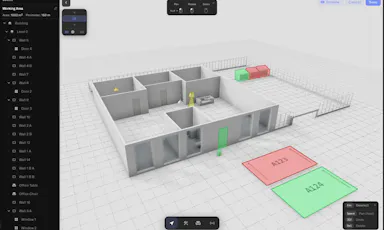
AI-first IoT platform that lets businesses describe what to monitor, then connects devices, writes automation rules, and escalates alarms until a human responds.

What to know
How it works
Provides a visual rules engine with versioning/rollback, two-way device control, an immutable audit trail, and live 3D building twins, scaling from one sensor to thousands.
Pricing
Start free.

Watched for 27 days · last checked 11d ago

Details →

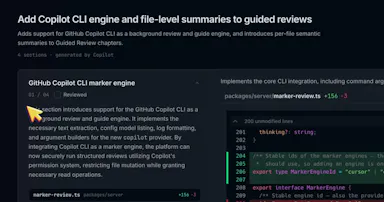
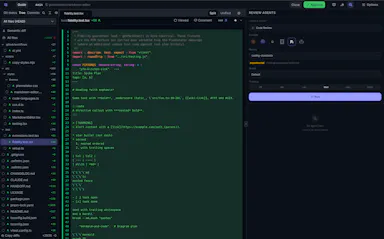
A free, open-source local diff viewer for reviewing AI-agent-written code across git, jj, Perforce and GitHub/GitLab PRs, with optional AI-assisted review - for developers.

FreeOpen sourceSelf-hosted
What to know
How it works
A local diff viewer for reviewing AI-agent-written code, supporting git, jj, Perforce, and GitHub/GitLab pull requests. You annotate lines and files, and those notes feed back into your agent session. An optional AI layer adds inline Q&A, guided reviews and launchable review agents.
What's different
Notes feed directly back into the coding agent's session rather than staying siloed in the review tool.
Pricing
Free, MIT / Apache-2.0 licensed, runs on your machine.
Best for
Developers reviewing large volumes of AI-agent-generated code across multiple version control systems.

Watched for 27 days · last checked 11d ago

Details →

A self-hosted agent that lets you talk to any REST API in plain English through its MCP layer, using your own LLM such as Ollama — built for developers.

Open sourceSelf-hosted
What to know
How it works
A self-hosted agent with an MCP layer that lets you talk to any REST API in natural language, using your own LLM (e.g. Ollama) instead of a hosted one.
What's different
Bring-your-own-LLM and fully self-hosted, so API credentials and data stay under your control.
Best for
Developers who want to interact with REST APIs conversationally while keeping their own LLM and data ownership.

Watched for 27 days · last checked 11d ago

Details →

Scans your Mac for node_modules folders and package caches eating disk space, with one-click cleanup to Trash. Scanning is free; cleanup needs a one-time fee.

FreeOpen sourcePay onceNo subscription
What to know
How it works
Lives in the macOS menu bar and shows what dev projects cost in disk space: every node_modules folder, the pnpm store, and every installed package with versions and security advisories. One-click cleanup always moves files to Trash rather than deleting with rm -rf.
Pricing
Scanning is free forever; one-click cleanup is a one-time 19 euro lifetime license at the founding price.
Best for
Developers whose Mac disk is filling up with node_modules and package caches across projects.

Watched for 27 days · last checked 11d ago

Details →

Soromi

Live

A workspace manager for AI coding agents like Claude Code and Codex, giving each project its own logins and terminals so agents keep running after you close the window.

What to know
How it works
A workspace manager for AI coding agents like Claude Code and Codex — each project gets its own terminals, login and folders, and you switch between them like Slack workspaces; agents keep running after the window closes and you can answer their prompts from your phone.
What's different
Deliberately small — no boards, personas or dashboards, just workspace isolation and persistence.
Best for
Developers running multiple AI coding agent projects who want separate logins and persistent sessions.

Watched for 27 days · last checked 11d ago

Details →

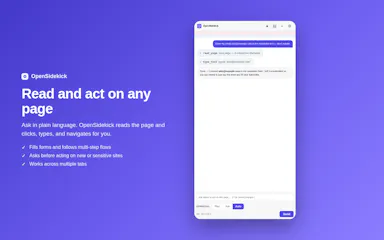
An open-source Chrome extension that lets an AI agent read and act on the page you're viewing, using whatever model you plug in, with API keys kept local and no telemetry.

No sign-upOpen sourceNo tracking
What to know
How it works
An open-source Chrome extension where an AI agent reads and acts on the page you're viewing, using any model you plug in — OpenRouter, OpenAI, Claude, Gemini, Groq, or a local model.
What's different
Model-agnostic and keeps API keys local in the browser rather than sending them through a vendor's servers.
Pricing
MIT license, no account required.
Best for
Developers who want a browser agent they can point at any LLM provider, including local models, without vendor lock-in.

Watched for 27 days · last checked 11d ago

Details →

Lynq

Live

An open-source Kubernetes operator: add a database row and it provisions a running app, deactivate the row to tear it down. Apache 2.0, for developers and DevOps teams.

Open sourceSelf-hosted
What to know
How it works
An open-source Kubernetes operator that treats a database as the source of truth for infrastructure — adding a row provisions a fully running, continuously reconciled app stack, and deactivating the row tears it down.
What's different
Infrastructure is driven by database rows rather than manifests or a separate deployment pipeline.
Pricing
Open source, Apache 2.0.
Best for
Developers and DevOps teams who want to provision and tear down app stacks by editing database rows.

Watched for 27 days · last checked 11d ago

Details →

PAI

Live

An early-stage project framing itself as a foundational layer for personal LLM-based computing, with no concrete features described in available text.

Watched for 27 days · last checked 11d ago

Details →

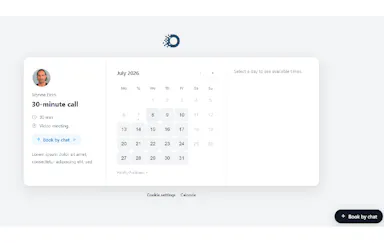
A self-hosted, open-source alternative to Calendly and Zoom that runs as one Go binary with SQLite — lets developers own their scheduling and video data instead of paying a subscription.

Open sourceCan export my dataSelf-hosted
What to know
How it works
A self-hostable alternative to Calendly and Zoom that runs as a single Go binary with SQLite, for booking meetings and hosting video calls with recordings saved to your own storage bucket.
What's different
Ships as one small, auditable Go binary instead of a subscription SaaS product, with recordings kept in your own bucket rather than the vendor's.
Pricing
Roughly 30 cents per month to run, versus a subscription; licensed Apache-2.0.
Best for
Developers who want to self-host their own scheduling and video-call data instead of paying for Calendly and Zoom.

Watched for 27 days · last checked 11d ago

Details →

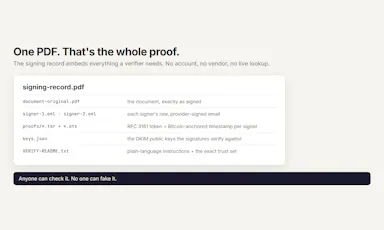
Lets you e-sign a document by forwarding it via email, using your provider's DKIM signature as proof instead of a signing company; open source, self-hosted or hosted, pay-per-document.

No sign-upWorks offlineOpen sourceNo subscription
What to know
How it works
Forward a document to the service and type 'I sign this document' — your email provider's existing DKIM signature becomes the proof of signing, bundled into one self-contained file anyone can verify offline in a browser.
What's different
No third-party signing company is trusted with the signature — the proof relies entirely on infrastructure (DKIM) that already exists and would still verify even if this service disappeared.
Pricing
4 free signatures, then $0.25 per document, no subscription. Open source (Apache-2.0) — self-host or use the hosted version.
Best for
People who need a lightweight, verifiable e-signature for occasional documents without paying for a full e-signature platform subscription.
Watch out
The provider states it never holds a signing key and can't forge or alter documents — that's the product's own security claim, not independently audited.

Watched for 27 days · last checked 11d ago

Details →

Paste a recipe link and get a clean, ad-free ingredient-and-steps card saved locally in your browser, not on a server; open source, works offline, no account needed.

No sign-upWorks offlineOpen sourceNo ads
What to know
How it works
Paste a recipe link and it strips out everything but the ingredients and steps, saved locally in your browser rather than on a server, with a cook mode that includes step timers.
What's different
Recipes are stored in your browser, not a server — open source (MIT) and works offline.
Pricing
Free, no account, no ads.
Best for
Anyone who wants a clean, ad-free recipe card without scrolling through a blog post to reach the ingredient list.
Watch out
Since recipes are saved in your browser rather than the cloud, they won't sync across devices — the page doesn't mention a sync or export option.

Watched for 27 days · last checked 2d ago

Details →

An open-source React textarea component for AI chat UIs, with mentions, slash commands, tags, markdown and attachments, installable via npm or shadcn.

Open source
What to know
How it works
An open-source React textarea component for AI chat interfaces, with @mentions, /commands, #tags, inline markdown, undo/redo, file attachments and dark mode built in.
What's different
Installable directly via npm or the shadcn registry — a drop-in component rather than a full chat UI framework.
Pricing
Free, open source.
Best for
Developers building a custom AI chat interface who don't want to build a rich text input from scratch.

Watched for 27 days · last checked 11d ago

Details →

The Control Plane and Network Layer For AI Agents

What to know
How it works
A control plane and global network connecting AI agents across different frameworks, providers and APIs, without opening inbound ports, setting up tunnels, or changing DNS/firewall rules.
What's different
Built on PubNub's existing real-time infrastructure (used by 113,000+ apps), applying that connectivity to agent-to-agent networking specifically.
Best for
Teams connecting AI agents across multiple frameworks and providers who need a network layer instead of custom point-to-point connections.
Watch out
This is PubNub's existing infrastructure repositioned for AI agents — worth knowing if you're evaluating it as a new product versus an established platform's new feature.

Watched for 27 days · last checked 11d ago

Details →

An end-to-end platform for building, deploying and monitoring AI agents and workflows — retrieval, orchestration, UI, observability and evals in one stack — for technical teams shipping AI products.

What to know
How it works
One platform to build AI agents and workflows, connect them to your data, design interfaces, then deploy, monitor, evaluate and govern them.
What's different
Consolidates retrieval, orchestration, UI, observability and evals into one stack instead of assembling them from separate tools.
Best for
Technical teams turning AI prototypes into production systems who don't want to stitch together five separate tools.

Watched for 27 days · last checked 1d ago

Details →