Tools that work offline, on your own deviceWorks with Cursor

20 match your filters — 17 of them answered our check today.

Watching this group for 20 days · how we check

This week3 new arrivals1 stopped answering

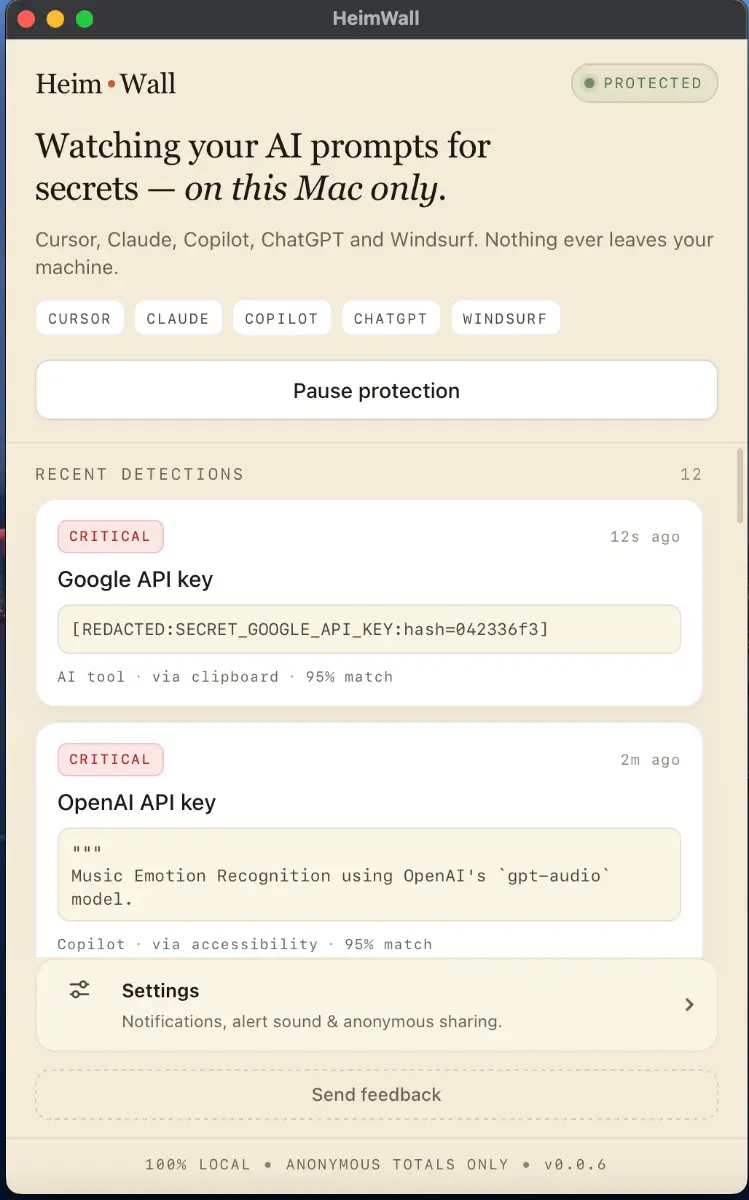
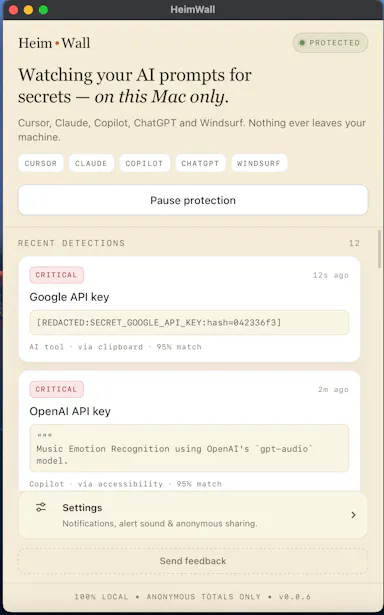
Local macOS scanner that blocks secrets and PII from leaking into AI coding-tool prompts, for engineers who don't want to rely on cloud DLP.

Domain registered 4 months ago

FreeWorks offline
What to know
How it works
A macOS app that scans prompts in real time before they reach AI coding tools like Cursor, Claude Code, and Copilot, flagging leaked API keys, credentials, and PII using 47 local detection rules in under 50ms.
What's different
Detection happens on-device before data leaves the machine, and uses soft notifications instead of hard blocks so it doesn't interrupt the coding flow.
Pricing
Free 15MB macOS application for engineers; an early-access dashboard is offered separately for organizations.
Best for
Engineers using AI coding assistants who want to avoid pasting live secrets into prompts.

Watched for 9 days · last checked 2d ago

Details →

Offline code-review studio for uncommitted git changes made by AI coding agents; comment on any line and hand notes back to the agent.

Works offlinePay onceNo subscription
What to know
How it works
open a repo, comment on diff lines, return notes to the agent via MCP
Pricing
one-time purchase, lifetime access
Best for
developers reviewing AI agent code

Watched for 6 days · last checked today

Details →

A free, open-source local app that lets multiple AI coding agents (Claude Code, Cursor, Codex, etc.) collaborate on one codebase over MCP while the user watches and approves each step.

FreeWorks offlineOpen source
What to know
How it works
Runs locally with no API keys or cloud account required; coordinates coding agents over MCP with step-by-step user approval.
Pricing
Free and open source.
Best for
Developers using multiple AI coding agents on the same codebase who want oversight of each step.

Watched for 7 days · last checked 1d ago

Details →

Recovers your work, git diff, uncommitted changes, architecture notes, when an AI coding tool like Claude, Codex or Cursor hits its limit, fully offline, one-time payment.

Domain registered 1 month ago

Works offlinePay onceNo subscriptionNo tracking
What to know
How it works
When an AI coding tool like Claude, Codex, Gemini, or Cursor hits its usage limit, ShardStitch recovers what's still on disk — git diff, uncommitted work, architecture notes, and last intent — without needing the AI tool itself. It can hand off that recovered context across 23 AI tools or restart clean in the same one.
What's different
Recovers session state entirely from local disk, without depending on the AI tool that hit its limit.
Pricing
One-time payment, no subscription.
Best for
Developers who rely on AI coding tools and lose in-progress context when a session hits its limit.
Watch out
Runs 100% local with zero telemetry, per the product's own claim — this hasn't been independently verified.

Watched for 14 days · last checked 8d ago

Details →

A local MCP server that gives AI assistants like Claude, Cursor and ChatGPT tools to act on your Mac — iMessage, Teams, WhatsApp, Mail, files — with nothing sent to the cloud.

FreeWorks offlineData stays with you
What to know
How it works
A local Model Context Protocol server running on a Mac that gives AI assistants like Claude, Cursor and ChatGPT 143 tools to act on iMessage, local Microsoft Teams chats, WhatsApp, Apple Mail, Calendar, Contacts, Notes, Reminders, Finder files, OneDrive, Outlook and Office documents.
What's different
Runs 100% locally with no cloud connection, reaching apps like iMessage and local Teams chats that cloud-based connectors can't access.
Pricing
Free.
Best for
Mac users who want their AI assistant to act across native apps like iMessage and Mail without sending data to the cloud.

Watched for 18 days · last checked 2d ago

Details →

IAXT

Live

A free macOS menu-bar app that logs everything your AI coding agent (Claude Code, Cursor, Aider, Codex) did in a session, entirely local with no account or cloud.

FreeNo sign-upWorks offline
What to know
How it works
A menu-bar app that passively records what AI coding agents like Claude Code, Cursor, Aider and Codex do on your Mac, every command, file touched, package installed, git operation, and launch agent, then presents it in an Action Log with confidence and severity tiers per agent, with any row copyable as context for another LLM.
Pricing
Free.
Best for
Developers using AI coding agents who want a record of exactly what those agents changed on their machine.

Watched for 18 days · last checked today

Details →

An open-source local MCP server that gives AI coding assistants like Claude Code, Cursor and Copilot a live map of your AWS setup, database schemas and infrastructure-as-code.

Works offlineOpen source
What to know
How it works
An open-source MCP server that gives AI coding assistants like Claude Code, Cursor, and Copilot a live, read-only map of your AWS services, database schemas, and infrastructure-as-code, including exact partition keys, Lambda event shapes, and misconfiguration warnings.
What's different
One command, zero config, runs 100% locally with no data leaving your machine.
Pricing
Open source.
Best for
Developers using AI coding assistants who want those assistants to understand their real AWS infrastructure instead of guessing.
Watch out
Read-only and local-only by design, but it does connect to your live AWS account to build its map.

Watched for 15 days · last checked 9d ago

Details →

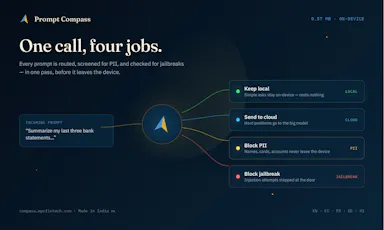
Routes each AI prompt to the cheapest capable model and blocks PII/jailbreak attempts locally, cutting AI API costs for developers.

Domain registered 4 months ago

Works offline
What to know
How it works
On-device ~5ms routing decision per prompt
What's different
Claims up to 96% cost cut by avoiding always-expensive-model routing
Pricing
Free tier, npm SDK and VS Code/Cursor extension

Watched for 6 days · last checked 5d ago

Details →

A free local VS Code/Cursor extension that turns your Claude Code session files into a browsable dashboard with full transcripts, tool calls, sub-agents and per-response token and cost tracking.

FreeWorks offline
What to know
How it works
A VS Code/Cursor/VSCodium extension that turns local Claude Code session files into a browsable workspace with full transcripts, tool calls, sub-agents, per-response token and cost tracking, an analytics dashboard, and a CLAUDE.md memory view.
What's different
100% local-first — nothing leaves your machine.
Pricing
Free.
Best for
Developers using Claude Code who want to review sessions, costs and tool calls without a CLI-only cost counter.

Watched for 13 days · last checked 11d ago

Details →

Gives AI coding tools like Cursor and VS Code persistent local memory of your codebase, running on your own machine - priced at $25/year, not one-time, apart from a limited beta deal.

Works offline
What to know
How it works
Gives AI coding assistants persistent memory: it indexes your codebase with vector search, saves every conversation, and connects to Zed, Cursor, VS Code and other MCP-compatible tools, running on embedded PostgreSQL + pgvector.
What's different
100% local-first with no cloud required, unlike most AI memory tools.
Pricing
$25/year, no tiers; beta testers get lifetime access for a $25 one-time payment.
Best for
Developers using AI coding assistants who want persistent, local memory of their codebase across sessions and team members.

Watched for 15 days · last checked 2d ago

Details →

A local gateway that lets every AI coding client share one set of MCP server connections instead of configuring each tool separately, cutting how many tools your agent has to load.

FreeNo sign-upWorks offlineOpen source
What to know
How it works
A local-first, open-source gateway. You set up and authenticate each MCP server once, and every connected AI client — Claude, Cursor, VS Code, Codex — shares that same connection instead of you configuring it per tool.
What's different
Claims up to 91% less tool-token overhead by giving an agent a handful of meta-tools instead of loading hundreds of individual tool definitions; API keys stay in the OS keychain.
Pricing
Free, open source, no sign-up.
Best for
Developers running multiple AI coding clients against the same set of MCP servers who don't want to re-authenticate each one separately.
Watch out
The '91% overhead cut' figure is the product's own claim; we haven't independently benchmarked it.

Watched for 20 days · last checked today

Details →

Pluks

Live

A clipboard manager for macOS and Windows that copies text the instant you select it, no Ctrl+C needed, plus a searchable history of your last 200 clips.

FreeNo sign-upWorks offline
What to know
How it works
A clipboard manager for macOS and Windows (beta) that copies text the instant you select it — no Ctrl+C/Cmd+C needed — then long-press to paste, or press Cmd/Ctrl+Shift+V to open a searchable history of your last 200 clips.
What's different
Brings the select-to-copy behavior Linux users know from PRIMARY selection to Mac and Windows; traditional clipboard managers only store history after you explicitly press copy.
Pricing
Free.
Best for
macOS and Windows users who want copy-paste without the extra keystroke.
Watch out
The Windows version is in beta.

Watched for 18 days · last checked 2d ago

Details →

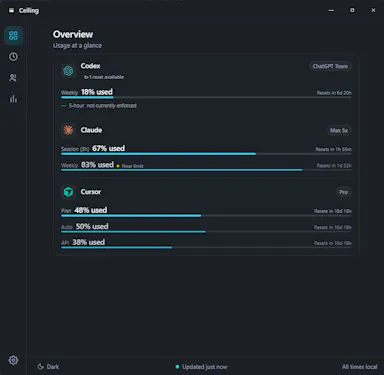
A Windows taskbar utility that tracks remaining usage limits and reset times across Claude, Codex, Cursor, and other AI tools.

FreeWorks offline
What to know
How it works
Keeps your remaining AI capacity and reset times visible above the Windows taskbar, alerting you when a limit comes back early or partially restores; hovering shows per-model and per-project breakdowns and an equivalent API cost.
Pricing
Free and local-first.
Watch out
Windows only; works with Claude, Codex, Cursor, Gemini, and Copilot.

Watched for 8 days · last checked 6d ago

Details →

Turns your Android phone into a self-hosted MCP server so AI assistants like Claude, Cursor or Perplexity can pull your personal memory without sending data to the cloud. Aimed at developers already using MCP-compatible tools.

Works offlineData stays with youOpen sourceNo subscription
What to know
How it works
Turns an Android phone into a self-hosted MCP (Model Context Protocol) server by installing a Python MCP server inside Termux, with a secure tunnel giving the phone a stable public HTTPS URL that AI clients like Claude, Cursor or Perplexity can connect to for persistent memory.
What's different
Data is stored locally on the user's own phone instead of a vendor's cloud, with no subscription or vendor lock-in.
Pricing
No subscription.
Best for
Developers already using MCP-compatible AI tools who want to own their memory data instead of storing it in the cloud.
Watch out
Relies on a relay tunnel (relay.memplato.com) and requires Termux running on the phone, with a watchdog to restart the server if the phone reboots or Termux closes.

Watched for 10 days · last checked 4d ago

Details →

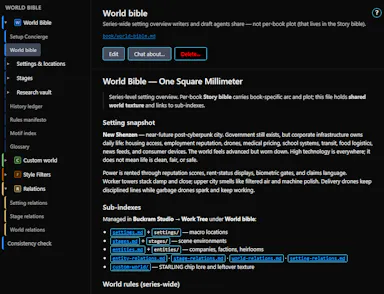
AI writing tool for authors that keeps persistent character and story lore linked to your draft, with local markdown files.

Domain registered 6 years ago

Works offline
What to know
How it works
Keeps a persistent Story Bible of character and lore details linked to the draft so context isn't lost across a long project, allows safe pipeline testing of editorial prompts on samples first, and stores everything as local markdown files.
What's different
Brings code-level context management to writers by turning Cursor into a local creative studio.
Watch out
100% local — markdown files stay entirely on the user's disk.

Watched for 9 days · last checked 7d ago

Details →

Offline on-device speech to text for Mac and Windows

No sign-upWorks offlineData stays with you

First seen today · last checked today

Details →

A CLI and proxy that curates your MCP server config and shares it across Claude, Cursor, VS Code and Windsurf, loading only the tools each agent needs — for developers juggling multiple AI coding clients.

Works offline
What to know
How it works
A local-first CLI and proxy where you write your MCP server configuration once, then it fans that config out to Claude, Cursor, VS Code, and Windsurf, loading only the tools each agent actually needs and resolving secret references instead of hardcoded keys.
What's different
Loads a curated subset of tools per client rather than every configured MCP server, avoiding the context-window overhead of loading them all.
Best for
Developers using multiple AI coding clients who want one MCP config instead of duplicating setup across each tool.

Watched for 16 days · last checked 2d ago

Details →

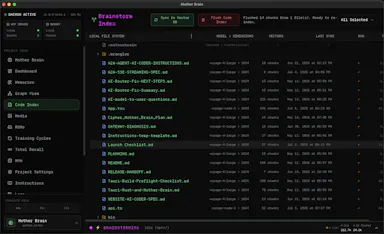
One usage meter for every AI provider you pay for

FreeNo sign-upWorks offlineOpen source
First seen today

Details →

A free, local-first CLI that reads logs already on your machine to estimate spend on AI coding tools like Claude Code and Cursor.

FreeWorks offline
What to know
How it works
A local-first CLI that reads logs already on the machine (no proxy, no traffic in the middle) to estimate spend on AI coding tools like Claude Code, Cursor, and Codex from published model pricing, printing monthly reports and shareable cards.
Pricing
Free; install via 'npx lmspend'. Optional dashboard adds history, budgets, alerts, and team roll-ups.
Best for
Individuals and teams wanting to track AI coding tool costs before the invoice arrives.

Watched for 11 days · last checked today

Details →

Deja Vu

Not responding

An open-source, local-first shared memory layer that lets ChatGPT, Claude, Cursor, and other AI tools remember your preferences across apps.

Works offlineOpen source
What to know
How it works
Gives ChatGPT, Claude, Cursor, Gemini, Perplexity, and local models a shared private memory that lives on your machine, so preferences and context are stored once and portable across tools.
What's different
Open-source and local-first.
Best for
People who use multiple AI tools and want their memory to belong to them.

Watched for 17 days · last checked today

Details →